
FLIP
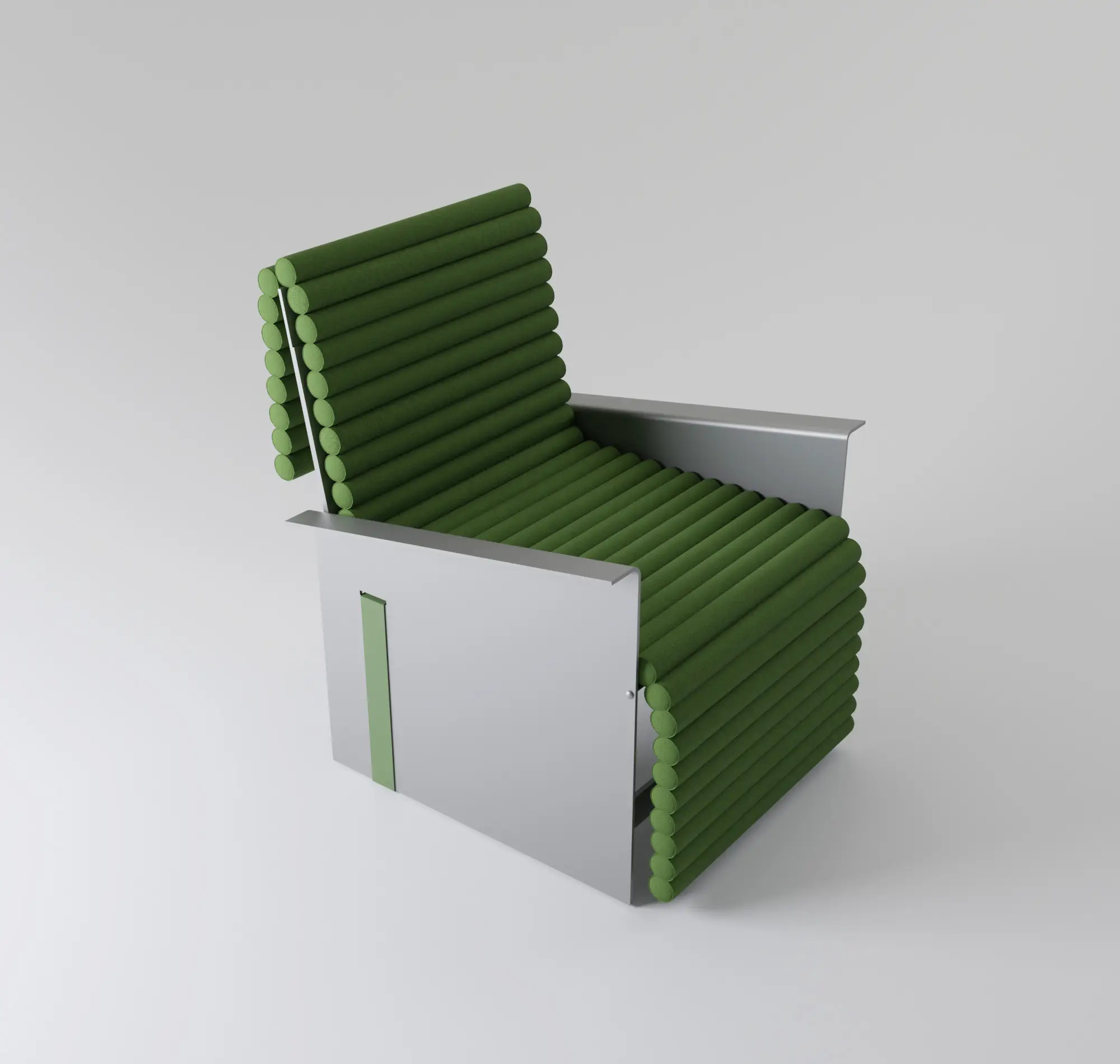
A personal project born from curiosity about seating and its mechanics. The goal was to create a cushioned chair that openly reveals its functioning, transformable into a comfortable chaise longue with an essential, clear language.
Conceived at the beginning of my design studies, the chair was driven by the desire to combine relaxation, transformability, and structural clarity.
Its exposed mechanics become an integral part of the aesthetic: a technical element that expresses movement and ergonomics, designed for a personal, domestic, and functional seat.
Bent aluminum frame and foam cushion upholstered in fabric: a balance between solidity and comfort. The elastic suspension is visible and part of the formal language.
The construction concept follows an industrial and modular logic. The frame is made of cut and bent aluminum sheets, with side panels joined by horizontal crossbars.
The cushion, composed of foam rolls sewn into fabric, can be repositioned between the two configurations.
The suspension mechanism uses a high‑resistance elastic band or safety belt, providing flexibility and comfort while keeping the function visible.
From sketch to prototype: drawings, scale models, mechanical tests, and 3D modeling. A continuous process of verification between idea, structure, and use.
The project began with sketches and small‑scale models made of plywood and rubber to test the damping principle.
It then evolved into detailed technical drawings and a full‑scale prototype in poplar wood, replacing the elastic with a seatbelt and tension springs.
3D modeling in Rhino and rendering in Blender refined the geometries, proportions, and transformation logic.
Two panels form the seat, while a pivot mechanism allows the transition from chair to chaise longue. Every visible element serves a precise, declared function.
The seat consists of two overlapping panels that rotate around a front pivot, turning the upper panel into a leg rest.
The side structures hold the supporting elastic and form the base, ensuring both stability and visual lightness.
The aesthetic, minimal and geometric, highlights the structure and functional components: no superfluous decoration, only necessary and legible elements.
The project is evolving: the next step will be aluminum prototyping and finish definition.
The next phase includes a final prototype using the intended materials, to test weight, resistance, and real comfort.
Research is ongoing on coatings and fabrics, both chromatic and tactile, to give the chair a more refined presence consistent with its technical essence.
The project remains an open laboratory exploring the relationship between structure, movement, and comfort.